

Many people dream of living abroad. There’s something almost romantic about packing up your life and leaving everything behind in search of something better; the promise of reinvention, the allure of the unknown, the hope that distance might unlock the person you’re meant to become.
It is exactly what I did 20 or so years ago. Somewhat impulsively.
My cousin invited me to a study abroad fair in São Paulo, Brazil in October 2006, and I landed in Toronto, Canada on December 6th, 2006.
Over the years, I’ve been constantly contacted by friends, acquaintances, and acquaintances of friends asking about the experience of moving abroad. They have dreams, questions, and very little idea of what it actually means to build a life somewhere new.
Global mobility is far more common now than it was back then. Remote work has normalized the idea of living anywhere. Digital nomad visas exist. Entire communities have formed around the expat experience.
But that doesn't make the move any easier. It's still a huge step.
This series is a hard-earned manual on what that journey looks like. From the moment you first land in your new country to the realizations that only come once you’re too deep to turn back.
I moved abroad, built a career, started a family, and never looked back. Well, mostly... It was the second best decision of my life (aside from marrying my wife).
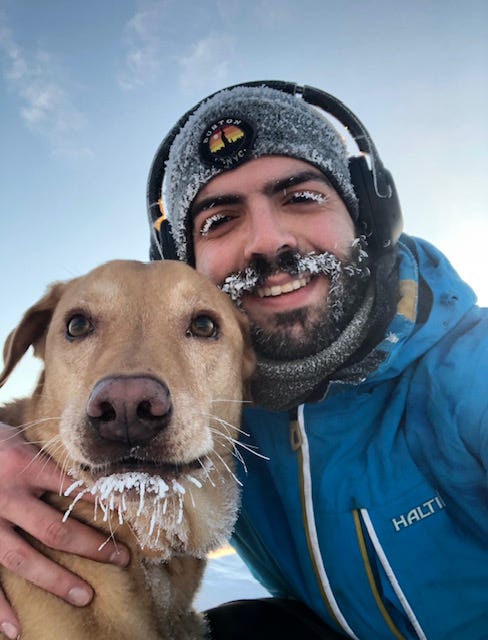
I hope you’ll find this series helpful, fun, relatable and who knows, maybe it can even help you decide whether a life abroad is right for you.
Part 1: Baby Again
One flight was all it took. And there I was… 5am, standing at Toronto Pearson Airport.
My friend’s brother picked me up wearing a, very familiar, São Paulo football jersey. He drove me back to his place and went back upstairs where his wife and kid were still asleep.
I sat down in his basement and turned on the TV. Hockey highlights came on. The commentator’s voice was indecipherable, and with it came, finally, the overwhelming feeling of “wtf have I done?”
A wave of anxiety hit me so hard my head spun. I’d only ever seen houses with basements in movies. Nobody plays ice hockey in Brazil (we have zero Winter Olympics medals for a reason; though I’m hopeful Brazilian-Norwegian alpine skier Lucas Pinheiro will soon fix that 😀).
My impulsive decision to quit university and move away from everyone and everything I had ever known had finally hit me.
Oh boy.

What no one tells you about moving abroad is that for the first few months, it’s kinda like being a baby again.
You can’t communicate properly. People around you don’t really understand you. The simplest tasks become complex challenges. You don’t yet know the world around you.
Yes, I spoke English. Thank you, Wizard English language school at Avenida Paes de Barros. At least I thought I did… until the first Canadian spoke to me and I realized my ears weren’t trained to pick up the rhythm, the accent, the speed of real conversation.
Just understanding the voice in the subway announcing the next stop was a challenge. “Was that Spadina? Bloor? Did I miss my stop? Yeah, I did. Again.” I’d stare at the map on the wall, tracing the colored lines with my finger like a child learning to read.
This was 2006. There were no smartphones. No Google Maps to tell me I was heading the wrong direction. No translation apps to help me decode a menu. I carried a folded paper map of Toronto in my coat pocket and a positive attitude.
In Brazil, I was Bruno Bin.
Son of Marcio and Rosa. Grandson of Aldo and Dirce. From Moóca. Went to this high school. Played football at that local club. These are the things that define you; the web of context and connection that makes you someone.
In Canada, just 24 hours later, that was all gone.
No one knew any of these people or places. The stories that made me me didn’t translate. I was a newcomer. An immigrant. I sounded funny. My sense of humor landed flat. I had no idea how to dress for the weather. (Vans and a hoodie are not a good idea in -25°C).

I can’t imagine doing this at a later stage in life; though I’m well aware many people do. I was only 19, full of energy and fight. Failure wasn’t an option. Going back home and proving everyone who doubted me right wasn’t either.
For now, building a sustainable routine and managing it with the resources I had was more than enough.
Improve my English. Get a job… any job. Try to have some fun along the way. That was the mountain in front of me.
TL;DR
If you’re thinking about moving abroad, here’s what that first chapter will look like:
1. You will feel incompetent; and that’s normal.
Even if you speak the language. Even if you’ve visited before. Living somewhere is different. You don’t know how the bus system works. You don’t know the products at the grocery store. You don’t know the unspoken social rules. Accept that you’ll feel lost for a while. It gets better.
2. Your identity will be stripped away.
Everything that made you you back home doesn’t exist here. You’re building from scratch. That can be terrifying, but it’s also liberating. You get to decide who you want to become.
3. Loneliness will hit harder than you expect.
Especially in those early months. You don’t any have friends yet. You don’t have routines. The weekends are long and quiet. Find connections as fast as you can.
4. The practical stuff is harder than you think.
Opening a bank account. Getting a phone plan. Finding an apartment. Navigating bureaucracy in a language that isn’t quite yours yet. Budget extra time and patience for everything. It will take twice as long as you think.
5. You need a reason to stay.
Moving abroad is romantic. Staying abroad requires purpose. A job. A partner. A goal. Something that gives you a reason to push through the hard days.
6. It gets easier, but it never gets easy.
Even 20 years later, there are moments when I still feel like an outsider. When cultural references fly over my head. But those moments become rarer. And the life you build becomes richer. Before long, home is both here and there; an advantage, with its own complications.
Moving abroad is less a leap and more a long adjustment. If you expect the discomfort and give yourself time, you’re more likely to make it through the first chapter; and stay.
✌️
I’ve never really thought about it this way. I worked in the UAE for about 1.5 years, but it never felt like a dramatic shift because there’s such a large Indian community there, it almost felt like a second home.
It would be interesting, though, to settle in a country with a truly different language and culture, somewhere that pushes you further outside your comfort zone.
So relatable, even I havent moved. My sister has. And I can feel her challenge through your words