

A quick housekeeping note: I've moved this newsletter from Beehiiv to Substack. If this email landed in your promotions or spam folder, please add it to your safe senders list so you don't miss future editions. Thanks for reading!
Every now and then, a company comes along and rewrites the rules—not just by building a great product, but by completely rethinking how they show up in the market. When it happens, you know it. And for the years that follow, you watch everyone else scramble to copy it.
Right now, that company is Lovable.
A quick recap, if you haven’t been paying attention
Lovable is a Swedish AI startup that lets anyone build fully functional software—apps, websites, products—just by describing what they want. No code required. Just chat with AI, and it builds.
The numbers are staggering. Launched in late 2024, Lovable hit $100M ARR in eight months—faster than OpenAI, Cursor, and Wiz. By late 2025, they were at $200M ARR. They recently raised $330M at a $6.6B valuation. All with a small team, built out of Stockholm.
It’s a 0 to 1 product. The kind that comes along once in a generation. And I think we’re only scratching the surface of what it’s going to become.
But here’s the thing: the product is incredible. That’s not what this post is about.
This is about how they’re growing. And specifically, how they’re doing it almost entirely through LinkedIn.
The playbook nobody saw coming
Most companies at Lovable’s stage would be throwing money at paid acquisition, performance marketing, and traditional demand gen. Lovable is doing something different.
They’re building a growth engine out of personal brands. And they’re doing it in a way that’s genuinely new.
There are three people at Lovable who are driving this strategy. Combined, they have over 400,000 followers on LinkedIn. Each one plays a different role. Each one uses a slightly different tactic. Together, they’re creating something that feels less like a marketing strategy and more like a masterclass in organic growth.
Let me break it down.
Anton Osika - The Visionary
Anton is the CEO and co-founder, with around 154,000 followers on LinkedIn. He’s the face of Lovable—but not in the way you’d expect.
Yes, he shows up in traditional media. Big outlets, podcasts, industry events. He talks about his vision for democratizing software creation, and he does it well. He’s young, compelling, articulate, and clearly believes in what he’s building.
But the tactic that stands out? The hire selfies.
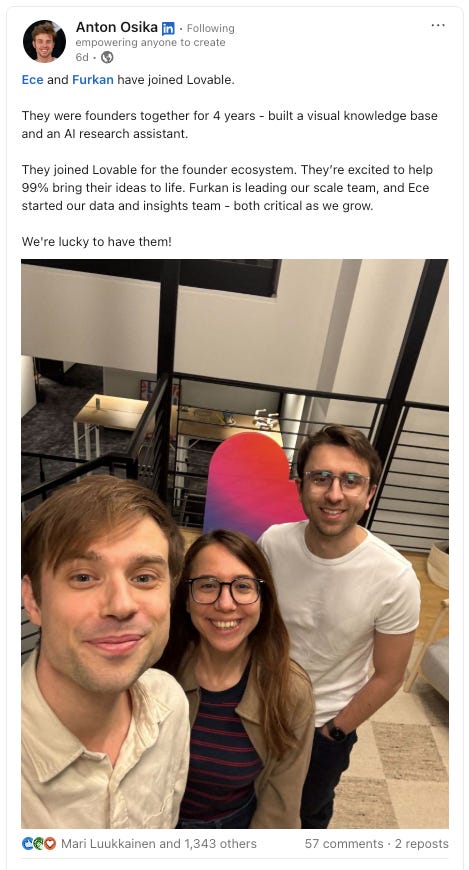
Anton has been consistently posting selfies with new key hires—former founders, impressive young talent, people who are clearly leaving big things behind to join Lovable. Simple posts. A photo of the two of them. A few sentences about who they are, why he’s excited to have them on board, and what they bring to the team.
It’s not flashy. It’s not polished corporate content. And that’s exactly why it works.
On the surface, it’s a talent acquisition play. Anton is signaling to the market: “Look at the caliber of people choosing to come here. Look at what this company is becoming.” It builds credibility, attracts more talent, and creates a feedback loop—every new hire becomes proof that Lovable is the place to be.
But it’s also brand building. It humanizes the company. It makes Lovable feel less like a startup and more like a movement. And it does it without spending a dime on ads.
I haven’t seen this done quite like this before. I have a feeling we’re going to see a lot of companies start copying this one.
He doesn’t stop there. Next come the creative showcases. Anton consistently shares the most impressive, creative uses of Lovable—the ones that make you stop scrolling and think, “Why didn’t I think of that?” These aren’t just product demos. They’re proof of what’s possible. They inspire people. They make the product feel limitless.
And it’s working. Companies like Microsoft are already starting to hire for “vibe coding”—a term that’s basically become synonymous with what Lovable enables. When your product creates a new job category? That’s not just growth. That’s a cultural shift.
In fact, according to Anton, Americans are now moving to Stockholm to join Lovable. What more can be said?
Elena Verna - The Growth Engine
Elena is the Head of Growth at Lovable, with around 189,000 followers on LinkedIn (can Anton catch up? 🙂). And if you’re in B2B marketing or growth, you probably already know her name. She’s been at Dropbox, Amplitude, Miro, SurveyMonkey—she’s one of the most respected growth operators in the industry.
Her LinkedIn strategy is sharp. Really sharp.
Here’s what makes it work: she layers product and company updates with memes (yes, memes!).
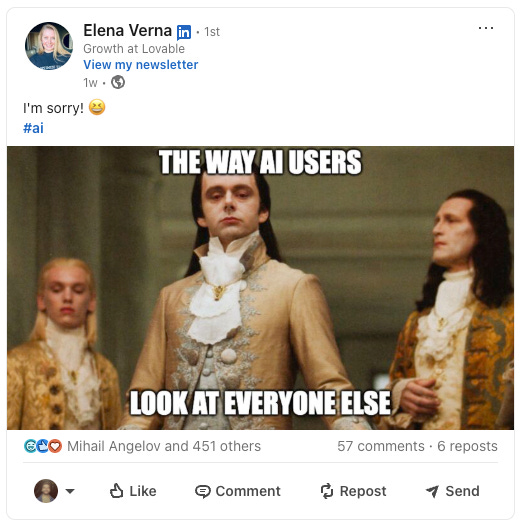
That’s it. That’s the tactic. But the execution is what makes it brilliant.
Elena doesn’t just post product updates and call it a day. She mixes in memes—funny, relevant, on-topic content that’s related to Lovable, growth, vibe coding, and the community she’s building around it. The memes drive engagement. They’re shareable, they’re relatable, and they pull in people who might never click on a product update alone.
Then, in between the memes, she drops the real stuff: product launches, feature updates, community wins. By that point, her audience is already engaged. They’re already paying attention. The product content doesn’t feel like marketing—it feels like a natural part of the conversation.
It’s a masterful content rhythm. And it works because Elena understands something most marketers don’t: engagement is the bridge to trust, and trust is the bridge to conversion.
Felix Haas - The Designer
Felix Haas is in design at Lovable, with around 89,000 followers on LinkedIn. And his content strategy is a quiet masterclass in how to build excitement around a product without it ever feeling like marketing.
Like Elena, Felix layers his content. But his hook is different: he builds things and shares them.
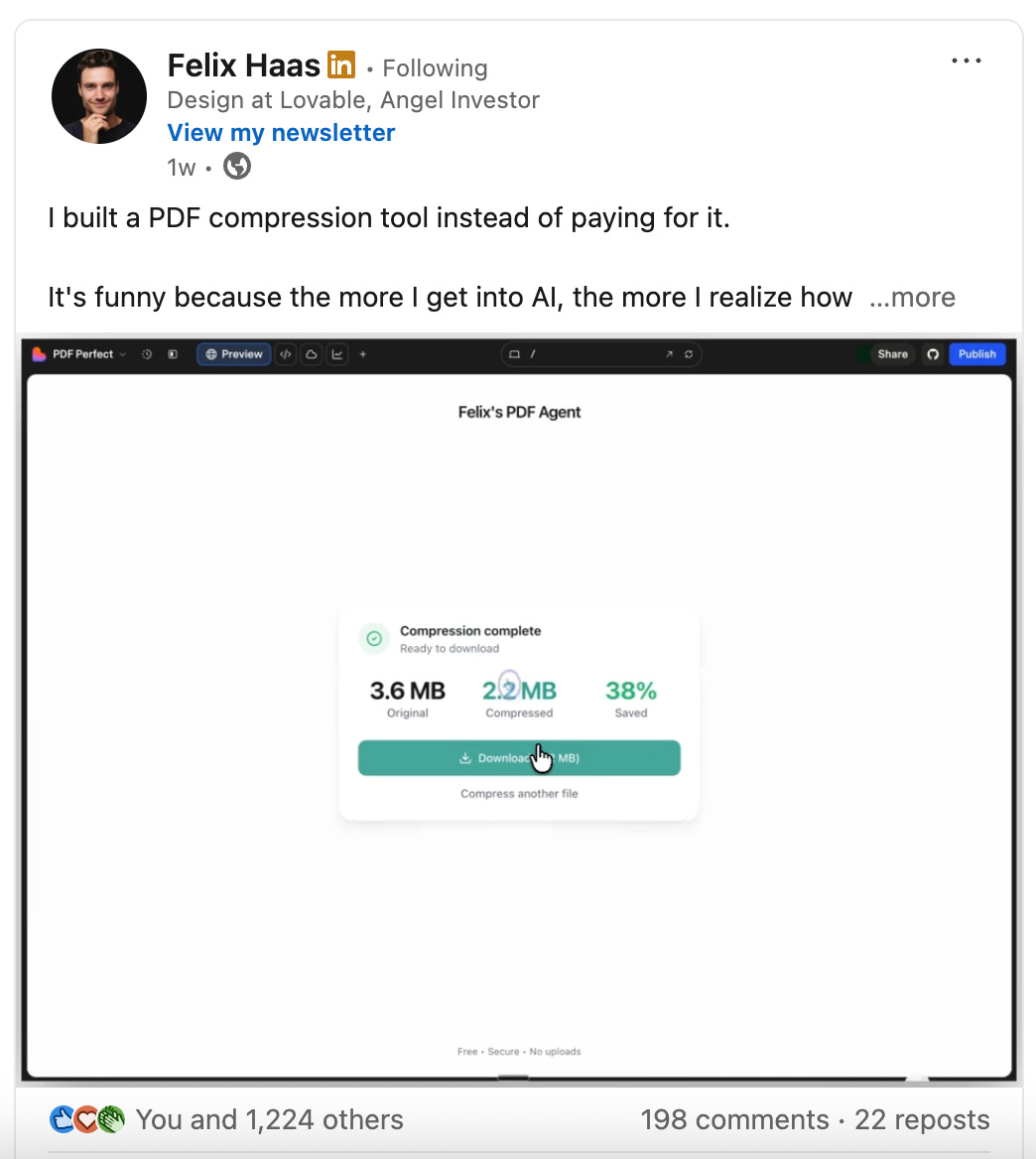
Cool demos. Creative experiments. Things he’s putting together using Lovable. Each post showcases what the product can actually do—not through polished marketing copy, but through real, hands-on examples that make you think, “I want to try that.”
And then, just like Elena does with her memes, Felix layers in product updates and announcements between the building posts. By the time the product news lands, his audience is already engaged, already excited, already paying attention. The updates feel like a natural part of the conversation—not an interruption.
It works on two levels. It gets people genuinely excited about what Lovable can do. And it attracts other builders and designers—people who see what Felix is creating and want in on it.
Felix’s content is quieter than Anton’s or Elena’s. But it’s doing something really important: it’s making the product feel alive. It’s showing people that Lovable isn’t just a tool—it’s a creative playground. And the way he mixes the excitement of building with the substance of product updates? That’s the same playbook Elena runs, just with a different flavor.
The bigger picture: what’s actually happening here
Here’s what ties all three together, and what makes Lovable’s approach genuinely different from what most companies are doing.
It’s not one person doing personal branding. It’s not a corporate social media strategy with a list of approved talking points. It’s a whole team—growing every day—each person surfacing as their own voice, flying the same playbook, building things and sharing them with the community.
And then? The corporate Lovable account reshares it all.
It’s a beautiful puzzle. Individual voices create trust and engagement. The corporate account amplifies it. New people join the company and immediately plug into the same rhythm. The hype compounds. The community grows.
This isn’t accidental. This is a growth strategy. It just doesn’t look like one.
And it works because of something we’ve known for a long time but rarely act on: people trust other people, not brands.
Lovable is proving that at scale. Right in front of us.
And they’re not done
Here’s what makes this even more interesting: they’re still experimenting. Still adding to the playbook. Trying new branches, seeing what sticks, and building on what works.
Lately? They’ve started offering badges for your LinkedIn profile—digital credentials that prove your competence in Lovable. It’s smart. It turns users into advocates. It creates a visible signal of expertise. And it feeds back into the LinkedIn ecosystem they’re dominating.
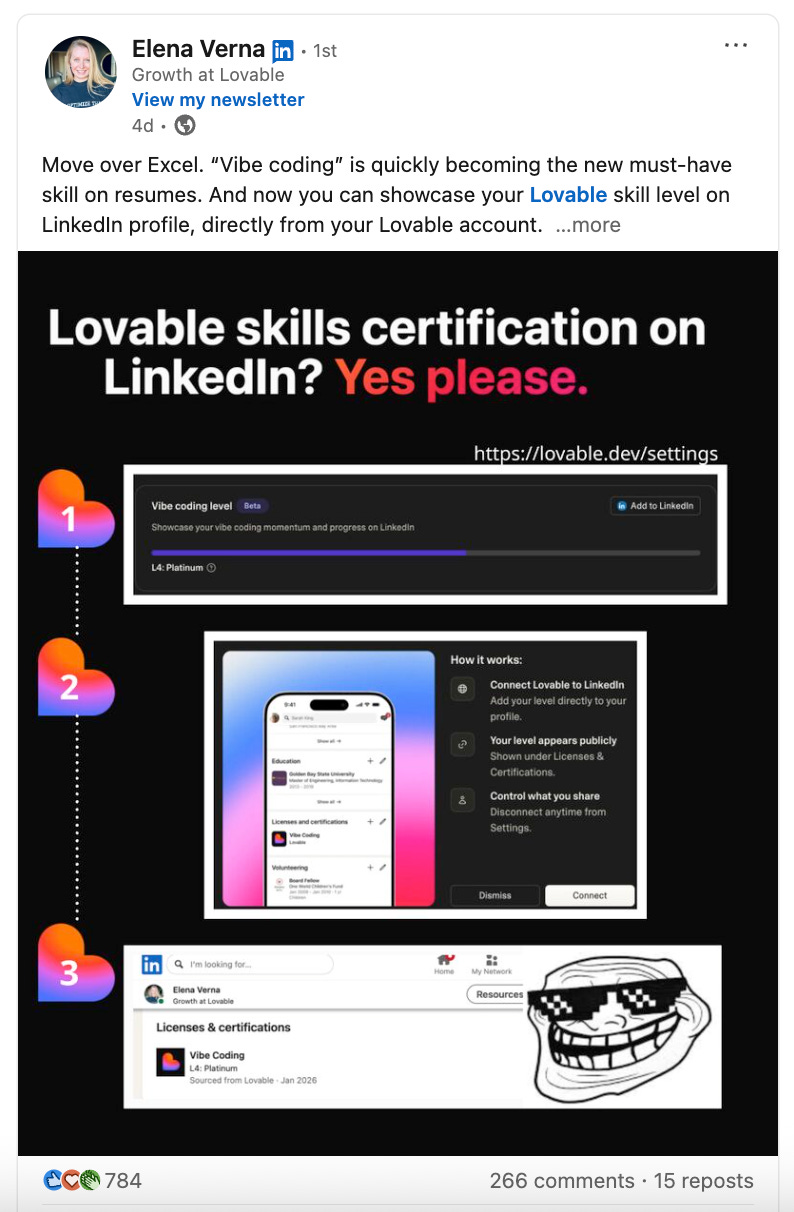
Will it work? Too early to say. But that’s not the point.
The point is they’re not sitting back and running the same playbook on repeat. They’re testing, iterating, and finding new ways to keep the momentum going. That’s what separates companies that capture a moment from companies that sustain it.
Why this matter for all of us
Here’s the bigger point, and the one I want to leave you with.
We are watching the future of how companies grow. And in that future, personal brands aren’t a nice-to-have. They’re the strategy.
Think about what this means for hiring. The best companies are already starting to look beyond your skills and experience. They’re asking: Can this person build an audience? Do they show up? Do they have followers who trust them?
It’s not about vanity. It’s not about being an influencer. It’s about building a portfolio that people can see, follow, and trust over time. It’s about having your work validate itself.
Now more than ever, building your personal brand isn’t something you do on the side. It’s something you invest in as seriously as you invest in your craft.
It’s not easy. It takes consistency. You have to show up week after week. It’s not an overnight hockey stick—it’s a compounding effort over time. There’s no shortcut.
But the shift is already happening. The best companies are going to start hiring for influence alongside capability. And the people who figured that out early? They’re the ones who’ll have access to the most valuable, and lovable, opportunities (see what I did there?).
Lovable is just showing us what that looks like at its best.
Pay attention.
✌️