


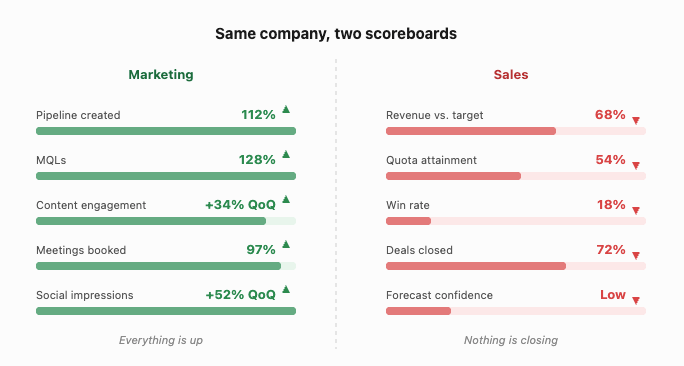
Sales says the leads are crap. Marketing says sales is not following up. Meanwhile, the business is missing its revenue number and the board is asking questions neither team wants to answer.
If you have spent any time in B2B, you have seen this movie. It plays on repeat at companies of every size, every stage, every industry. The script barely changes.
Here is my honest take after 15 years on the marketing side of this. Most of the time, sales is right.

I know. Coming from a marketer, that stings a little. But think about it…
Sales reps want to make their number. They have quota, they have commission, they have a leaderboard staring at them every morning. They have zero incentive to ignore a good lead. When they say the leads are not converting, the instinct from marketing is to get defensive. The reality is that, in most cases, sales is telling you something you probably already know but do not want to say out loud.
Marketing knows when the leads are not great. But when that is all there is, what are you supposed to do? You still have to show pipeline. You still have to fill the funnel. So you keep passing volume and hoping the numbers work out.
That is where the problem lives. And it starts with what marketing is measuring.
Marketing should own pipeline, not MQLs
If your marketing team is still reporting MQLs to the board, you are already behind. The metric that matters at the highest level is qualified pipeline. Actual dollar value of opportunities that sales has validated and is working.
I am genuinely surprised that there are still marketing leaders in 2026 who are not tracking toward that number. Pipeline is what connects marketing’s work to revenue. Everything else, meetings booked, MQLs, content engagement, social metrics, those are supporting indicators. They matter for the team internally. They help you diagnose what is working across channels. But they are not what you bring to the board or to your sales leader.
When marketing starts owning pipeline, the conversation with sales immediately changes. You are speaking the same language. You are looking at the same scoreboard.
But here is where it gets tricky.
Pipeline generated can be green while revenue is red
Most marketing teams that reach this level of maturity track pipeline generated in a given quarter. You have a target, usually a multiple of the revenue number based on your historical win rate. If you close one in four opportunities on average, your pipeline target is 4x revenue. You know the math.
And marketing can hit that number. Quarter after quarter. Green across the board.
Meanwhile, sales is still missing revenue.
How is that possible? A few reasons.
Pipeline created and pipeline that is actually going to close are two very different things. You can generate $3M in Q1, but if none of those deals close until Q4, that does not help the rep who needs to make the number in Q2. On top of that, the business underneath you keeps changing. New sales leadership with a different qualification approach. Reps ramping in a new region. A shift in strategy that changes which segments you are going after. Quarter over quarter, you are often not comparing apples to apples, and a pipeline number that looks consistent on paper can mean very different things depending on what changed around it.
This is where I like to bring in a complementary metric: in-quarter closing pipeline coverage. Pipeline with a close date in the current quarter, and what multiple of the revenue target it represents.
Say you need to close $1M in Q3. If you have $3M in pipeline with close dates in Q3, that is 3x coverage. That tells you how healthy your position actually is in the quarter where the money needs to come in.
Deal concentration is what makes or breaks your coverage
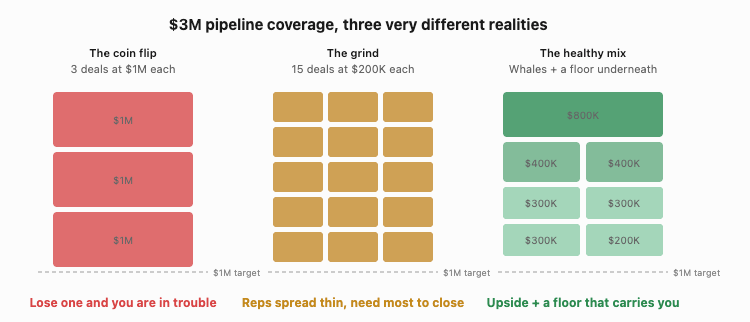
$3M in coverage sounds solid until you realize it is made up of 3 deals at $1M each. You close one, you make the number. You lose one, and now you have a 50/50 chance of fully missing the quarter. Get the point? That is not a pipeline. That is a coin flip.
But 15 small deals at $200K each is not ideal either. Your reps are now spread across a lot more opportunities, each one still needs to be worked, and you need to close most of them to make the number.
What you actually want is a mix. A few big whale deals that can move the needle significantly, combined with a layer of smaller, faster-closing opportunities underneath. The whales give you upside. The smaller deals give you a floor and carry you quarter after quarter. That balance is what makes deal concentration healthy and gives you real confidence in the forecast.
And this connects back to the pipeline generation point. A rep adds a single deal for $1.5M. Suddenly your pipeline created number for the quarter looks fantastic. Marketing is celebrating. But your deal concentration to confidence ratio in a future quarter is now extremely volatile.
When you start looking at pipeline this way, it forces you to ask the hard questions about what you are generating upstream. Are you building pipeline that gives sales a real shot at making the number? Or are you creating big headline numbers that look good in a slide but crumble under pressure?
Honest numbers end the blame game
When you strip away the vanity layer and get real about where your pipeline actually stands, something interesting happens. The marketing and sales war quiets down. Not because everyone suddenly agrees, but because you are finally working together.
Marketing stops hiding behind volume. Sales stops blaming lead quality for everything. And when the numbers are honest, the actual problems become visible. Maybe you do not have enough opportunities in mid-stage. Maybe your average deal size is too concentrated in a few large bets. Maybe the pipeline you are generating is solid but the sales cycle is longer than anyone wants to admit.
Those are solvable problems. The blame game is not.
Before you pick a side
I said at the top that most of the time, sales is right. I stand by that. But I am not saying it to throw marketing under the bus. I am saying it because most people in other departments massively underestimate the complexity of marketing’s job.
If you think marketing just needs to find the right buyers, tell them the story, and get them through the funnel, you are assuming the company has it all figured out. Most companies do not.
They are still learning what they want to be. Product-market fit is a work in progress. You can sell to a lot of people, but really understanding who cannot live without your product, the true core ICP; that takes time. The business model might still have challenges. The go-to-market strategy shifts every few quarters.
Marketing sits in the middle of all of that. And the job is really two jobs at once.
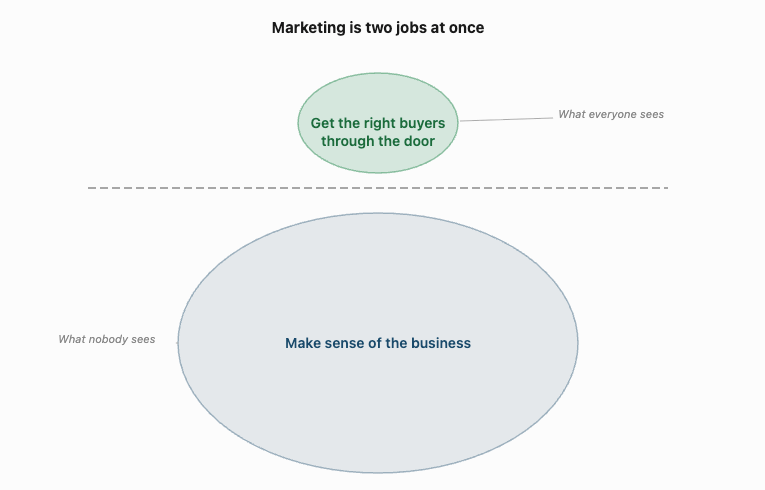
The first is making sense of the business. Working with leadership and product to figure out who truly gets value from what you do, what you need to say to them, and what problem you are actually solving. And doing that while navigating departments, personalities, founders and execs with strong opinions, and product teams with their own vision, all to find what actually makes the company special. That is product marketing at its most strategic, and it is some of the hardest work in the company.
The second is getting the right potential buyers through the door. Building pipeline, running campaigns, enabling sales, driving the conversations that turn into revenue.
That is a tough job.
The marketers who figure out both are doing something much bigger than what the role looks like on paper. I have been reading more and more about how CMOs who are good at this end up becoming CEOs. That makes sense to me. Take a messy, evolving business, turn it into a clear story, and build the engine that drives revenue around it.
That is not a marketing job.
It’s a company-building one.