


Everyone in my circles is talking about AI. I work in tech, so that’s not exactly news, and if you read this blog you know I’ve written plenty about how we’re changing the way we work at Rocket.Chat.
But the last month felt different. I took on some new challenges, and while working through them I realized how fast these models are moving. Some of what I’ve done in the last few weeks simply wasn’t possible four months ago. A lot of what I used to file under hype is starting to actually work.
The short version: if you know where you’re headed, one person can now move at a speed that’s hard to believe. Being able to build almost anything you can imagine has become table stakes. I’ve always said on this blog that the craft is what counts and the tools are just tools. I still believe that. What’s changed is how much the tools can do in the hands of someone who knows the craft.
Rick Rubin’s job description
A teammate brought up a Rick Rubin interview I remember watching years ago. Rubin says he doesn’t play any instruments, doesn’t know music theory and barely knows how to work a soundboard. What he does is trust his taste. His job is to know when something is good, when something needs to change, and when it’s done.

That’s the best description I’ve found of what the last month felt like. AI has turned almost everything except that judgment into table stakes.
I can’t fully define that judgment, but I can see it. The people who have it can now run on their own at an unbelievable pace, and the gap between them and everyone else is growing fast. In the hands of someone without it, AI just produces slop, and plenty of companies are already flooding their buyers with it.
I also think the old line “you can tell it’s AI” is changing (also, how cares?). Soon what you’ll be able to tell is who used it superficially. When you go deep and the AI learns your company, your style and your voice, it catches up to the quality you used to produce by hand surprisingly fast. Then it starts doing things you never could.
Why this hits differently for us
Rocket.Chat is a technical product with a lot of concepts that are hard to explain. That’s true for internal training, and it’s even harder when we’re telling the story to prospects, and to everyone beyond the experts who already get it.
The business side has its own layers. We have paid plans and free plans on the open source side, and at a certain version we introduced a different free plan with its own capabilities and limits. Put it all together and it’s hard for any person to turn that into clear value for every audience, even after years of living in it.
For AI, synthesizing that kind of complexity is a walk in the park. Add design, building and coding on top, and suddenly you can go to market with work that would have been out of reach for a team our size.
What the last few weeks looked like
We have a few open roles we’re hiring for right now. Normally that would mean falling behind. Instead, the team has kept up with everything and is thriving, and this technology is the reason.
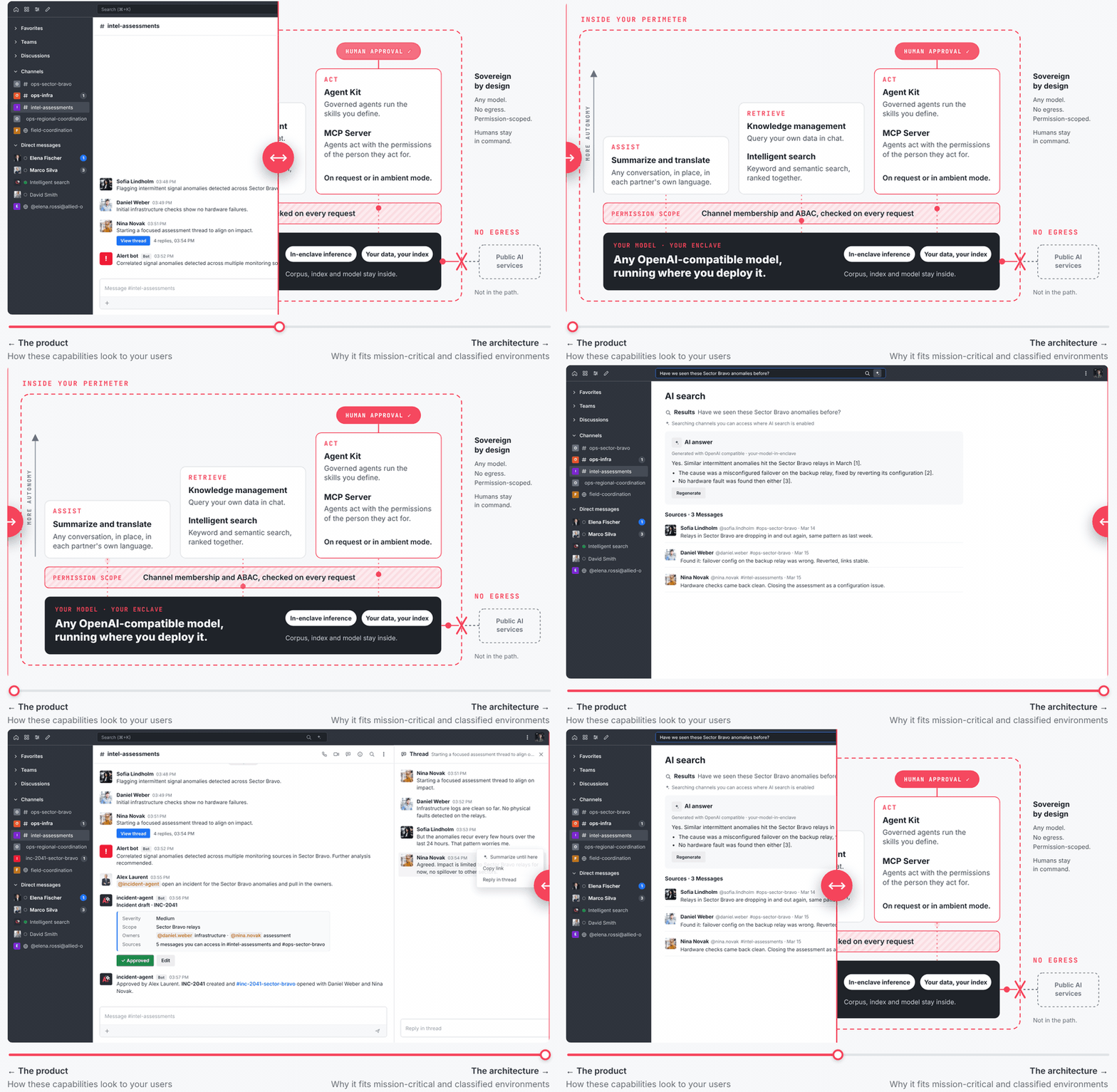
In the last few weeks, we’ve built a brand new website with ICP photos, product animations and architecture diagrams, plus a new brand that’s aligned with our buyers and on message. On top of it came sales decks for our different markets and segments, two enablement decks, flyers for a global cross-sell campaign, and materials for events in Europe, the US and around the world, from roll-up banners to swag. We also built every launch asset for an upcoming product release in about an hour, and an internal training quiz that stays in sync with our messaging. I’m running with a lot of this myself, and most of it isn’t live yet.
Take the product walkthrough. Our product does a lot, and explaining all of it has always been hard, for our own team as much as for buyers. So I built a walkthrough with more than 30 chapters covering pretty much everything the product does, in a logical order with an intro and an outro. Every chapter has real product UI video, diagrams and voiceover.
It took about two days in between meetings and regular work, all from prompts. A single video like one of those chapters used to take weeks, so the whole thing would have been a year of someone’s full-time work. Now it’s how we’ll handle internal training, partner enablement and demand generation.
Here’s a quick sample so you see what I’m talking about:
The part I’m proudest of is what happened with sales. Instead of new requests piling up, the materials started getting compliments. And our sales team and CSMs can now take the core decks and customize them with AI for a customer or a partner, small changes or big ones, while staying on brand and on message. They do it quickly and on their own.
That used to be a never-ending wheel of work where it felt like we never moved forward. It’s mostly behind us now, which is still hard for me to say out loud.
And it keeps getting better. The more you use it, the better it understands you, and the better you get at working with it.
Everyone needs to understand the business now
If there’s one thing I’d want people to take from this post, it’s this part.
For a long time, you could build a great career on a specialized skill. You could be an excellent designer, writer, video editor or campaign manager without knowing much about the product, the market or the buyer. Someone handed you a brief, and your craft did the rest.
That’s done now. AI can handle a lot of the execution, and it gets better at it every month. What it can’t do is decide what’s worth building, for which buyer, and what a great version looks like for them. That’s the judgment Rubin talks about, and in a company, that judgment comes from understanding the business.
You can already see it on our team. When someone really gets our buyers and how they use the product, they can take an idea from start to finish on their own, at a quality we couldn’t reach before. A designer who understands the use case can make a product video that explains something complicated in a minute. A content person who understands the buyer’s world can write something that buyer forwards to their boss. A rep who knows the product deeply can rebuild a deck for a specific meeting in minutes.
So my advice to anyone reading: go deep on the business. Learn the product until you could demo it. Sit in on calls. Read the deal notes. Ask sales what they’re hearing. Understand the strategy and why the company makes the bets it makes. Every hour you put into that pays off many times over, because the tools will turn that understanding into great work faster than ever.
It also changes how we hire and how we build teams. Craft still counts, a lot. And the people who combine it with a deep understanding of the business are the ones who can now run on their own and deliver far more value than before.
The opportunity in front of us
This is where things stand today, and it’s improving fast. The way we work, the way teams are built and the way companies run are all changing right in front of us.
The best part is that this is open to anyone willing to learn. You don’t need a technical background or a special title. You need curiosity, a real understanding of your business, and the patience to keep iterating. I’ve watched our team pick this up fast and do work we’re all proud of, and we’re only getting started.
✌️