

Most B2B marketing teams are doing everything right on paper.
Content calendar? Full. Ads running? Check. Blog posts shipping? Weekly. Leads coming in? Sure, some.
But here is the question nobody wants to ask out loud.
When a buyer in your category finally has budget, finally gets the green light, finally sits down to make a shortlist... is your name in the room?
For most companies, it is not.
Not because the product is bad. Not because the team is lazy. But because all that marketing activity produced noise, not memory. The pipeline looks busy. The brand is invisible.
That is not a lead gen problem. That is a recall problem.
The gap between activity and memory
Most marketers know this but rarely act on it: according to the Ehrenberg-Bass Institute, roughly 95% of your buyers are not in-market right now. They are not clicking your ads, downloading your eBooks, or requesting demos. They are going about their day.
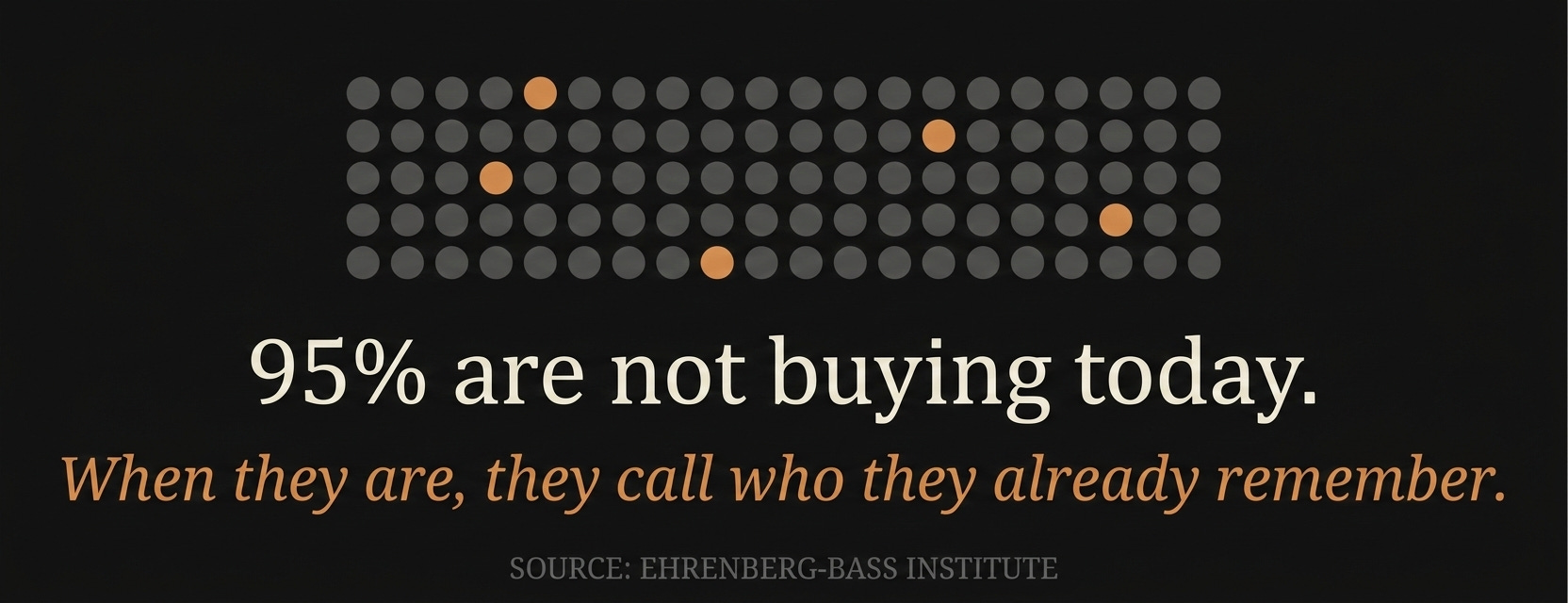
But they are forming impressions. Every touchpoint, every post, every interaction with someone at your company is either building a mental shortlist or it is not.
When the buying window opens, the companies on that shortlist get the call. Everyone else gets Googled, maybe, if there is time.
So what makes a brand stick in a buyer’s head long before they are ready to buy?
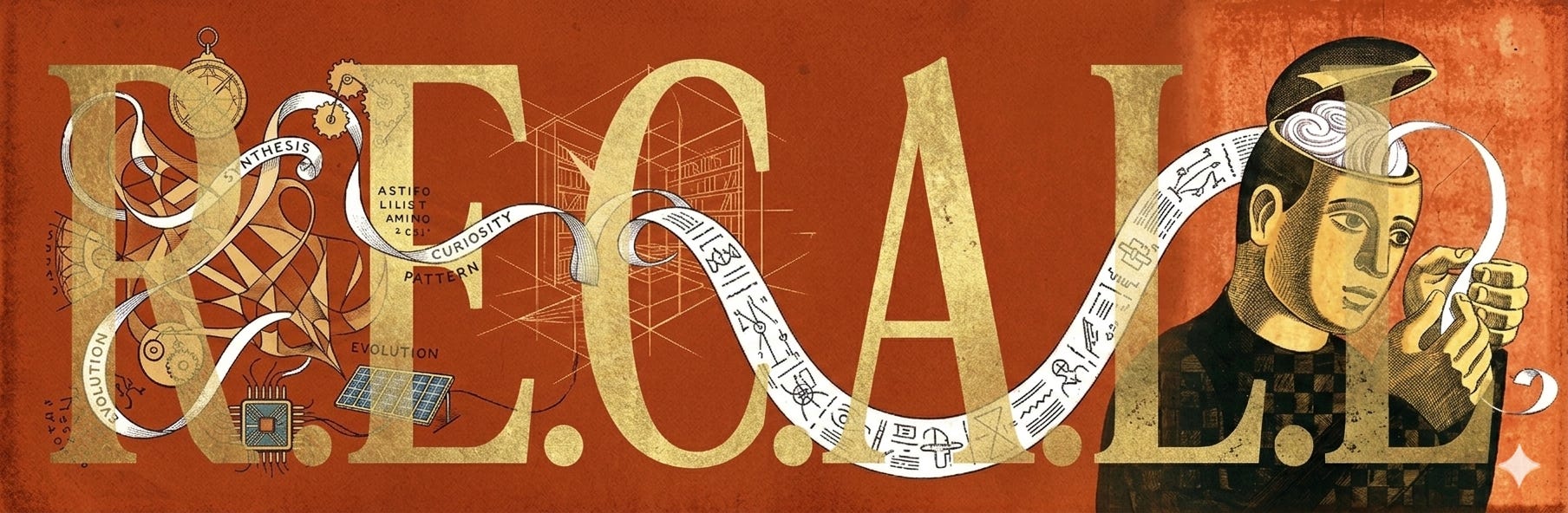
Six things. I call them R.E.C.A.L.L.
R: Repetition
Not saying the same thing over and over. That is annoying. Repetition is showing up consistently with something valuable, so often that your name becomes automatic.
The brand that shows up 50 times before the buying trigger wins over the one that shows up once with a gated eBook. Every time.
If your marketing strategy depends on catching buyers at the exact right moment with the exact right ad, you are playing a lottery. Repetition turns the lottery into a sure thing. Show up often enough with something worth paying attention to, and when the moment comes, you do not need to chase it. You are already there.
Look at your last six months of content. Would your target buyer recognize your name from it? Or would they scroll right past?
E: Edge
Safe brands disappear.
The ones with a sharp point of view, a take that makes people stop scrolling, a stance that rubs some people the wrong way. Those are the ones that stick.
Gong did not become Gong by saying “sales is important.” They came in with data that challenged how people thought about their own sales calls. They made people uncomfortable. They had an edge that was impossible to ignore, and it made every competitor in revenue intelligence feel generic by comparison. They were the purple cow.

If your messaging sounds like every other company in your category, you do not have recall. You have wallpaper.
Now think about your own brand. If you removed the logo from your content, would anyone know it was you? If the answer is no, you are blending in. And blending in is just a slow way of becoming invisible.
C: Clarity
If a buyer cannot explain what your company does in one sentence, your marketing has failed at its most basic job.
(side note: bad messaging starts upstream. Unclear positioning, unclear strategy. Marketing alone cannot fix what the company has not figured out yet.)
And that failure poisons the entire company. Sales tells a different story than the website. The product team gets pulled in ten directions by customers who never should have been customers. Support drowns in tickets from people who bought the wrong thing. It goes way beyond marketing.
Drift understood this. They did not say “we sell chatbots” or “we do real-time website engagement.” They created a category: conversational marketing. A buyer could explain what Drift did before ever talking to sales. That clarity was not just good marketing. It was the foundation everything else was built on.
The clearer the message, the faster it sticks. If your positioning needs a paragraph to explain, it is not positioning. It is confusion with a logo.
A: Availability
Stop gating your best content behind forms. Stop making buyers jump through hoops to learn from you.
Look, I get it. You spent weeks on that report. You want something back. An email address. A lead. Something to show for it.
But here is what actually happens: the buyer hits the form, weighs whether your content is worth giving up their inbox, and most of the time decides it is not. Your best thinking dies behind a gate that 90% of your audience will never open.

The brands that give more than they capture are the ones buyers remember when the buying window opens. Make your best thinking easy to find, easy to consume, and easy to share. That is not charity. That is strategy.
When someone learns from you for free, repeatedly, over months, you are not losing leads. You are building the kind of trust that no form fill will ever create.
L: Leaders
Not your logo. Not your corporate LinkedIn page. The trusted voices your buyers actually follow.
People trust people, not brands. This is not new. But very few companies actually build around it.
Drift did not just have a great product and a clear message. They had Dave Gerhardt. A VP of Marketing who built a personal brand so strong that he arguably did more for Drift’s awareness than their paid budget ever could. When Dave talked, people listened, and Drift was always part of the conversation.
The companies that figure this out have a massive advantage. One credible person saying your name is worth more than a hundred ads saying it for you.
Think about the brands you trust most in your space. Chances are, you can name a person behind them before you can name a product feature. That is not a coincidence. That is the strategy.
L: Listening
None of the above matters if you do not deeply understand your buyer’s world. Their frustrations. Their identity. What they actually care about when no vendor is in the room.
This is the letter most companies skip. They jump straight to repetition, to content, to campaigns, without ever sitting down to understand who they are actually talking to.
And you can feel it. You can feel when a brand gets you and when it does not. When the messaging lands on something you have actually felt versus when it sounds like someone ran a keyword report and called it research.
Listening is not a survey. It is not a focus group. It is immersing yourself in the conversations your buyers are having without you. The communities they are in. The frustrations they share with peers. The way they describe their own problems in their own words.
That is the foundation that makes every other letter work.
Start here. Always.
The audit
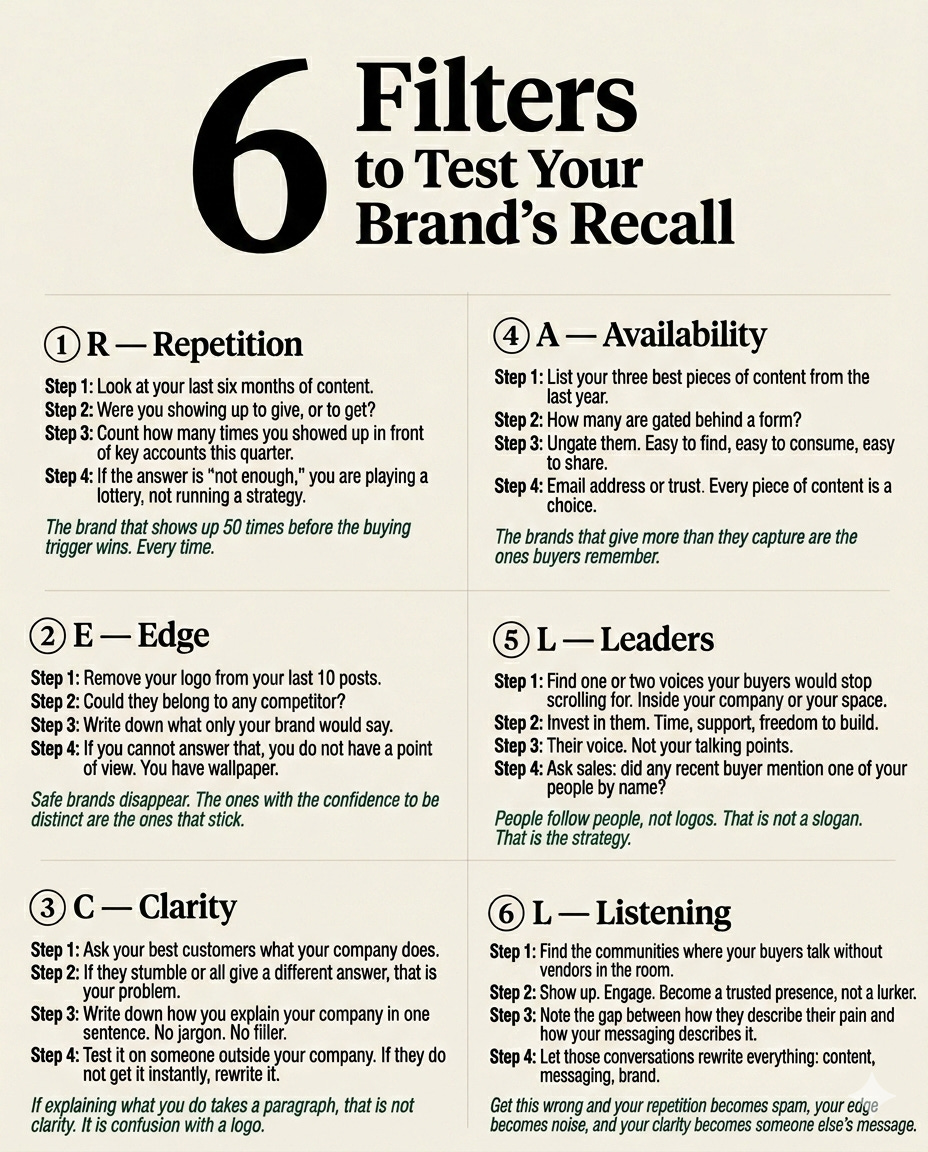
Here is the uncomfortable part.
Run your own marketing through these six filters. Be honest about where you land.
Are you showing up often enough to be automatic, or just often enough to check a box? Do you have a point of view that actually stands out, or are you blending in and calling it “professional”? Can a buyer explain what you do in one sentence? Is your best thinking easy to access, or locked behind a form? Are there real humans at your company building trust with your audience, or is everything coming from a logo? And do you actually understand your buyer’s world, or are you guessing?
Most companies will not score well on all six. That is normal. The point is not to be perfect. The point is to know where the gaps are so you can start closing them.
Because in the end, the company that gets remembered is the company that gets the call.
And the one that does not? They are still wondering why their pipeline is full of leads that go nowhere.
✌️