


There are about 200 commercial airlines in the world. Roughly 60 major stock exchanges. Around 440 nuclear reactors, operated by maybe 50 utility companies. A couple hundred advanced semiconductor fabs. Nine container shipping carriers control 80% of global capacity.
If you sell technology into any of these industries, that is your entire addressable market. The whole thing. But the revenue potential per account is massive, which is what makes these businesses valuable despite the small numbers.
Now run that through the B2B playbook everyone swears by. Top-of-funnel content. Paid ads. Lead scoring. Nurture sequences. Webinars to capture MQLs.
It breaks immediately. When your whole market fits in a spreadsheet, that playbook either does not apply or changes significantly, playing much more of a supporting role.
A lot of B2B operates in markets exactly like these. The people inside them know the standard advice was not written for them. Most of them are still trying to make it work anyway.
In this article, I am going to pick one of these as a figurative example. Stock exchanges. About 60 of them worldwide. I‘ll walk you through what a go-to-market could look like and what the key marketing principles are when you know every potential buyer by name.
1. Your TAM is a contact list
In a typical B2B company, marketing exists to find buyers you do not know yet. Cast the net, pull them in, qualify them, hand them off. In a finite market, you already know every single one of them. You probably have their names.
So the entire job becomes making sure that when the buying window opens at any of those accounts, your name is already in the room. (I wrote about the idea of R.E.C.A.L.L. in a previous post. How you build it might look a little different in a market like this, but its importance only goes up.)
2. Tier your market. Start in the middle
The instinct when your market is this small is to go after the biggest accounts first. The NYSE. The London Stock Exchange. The logos that would look incredible on your website and signal to the rest of the industry that you have arrived.
Resist that.
Those accounts have the most complex procurement, the longest sales cycles, and the highest expectations. If you land one before you are ready and something goes wrong, that failure does not stay quiet. In a market of 60, everyone talks. One bad experience becomes a story that follows you for years.
Instead, tier your market into three segments and work them differently.
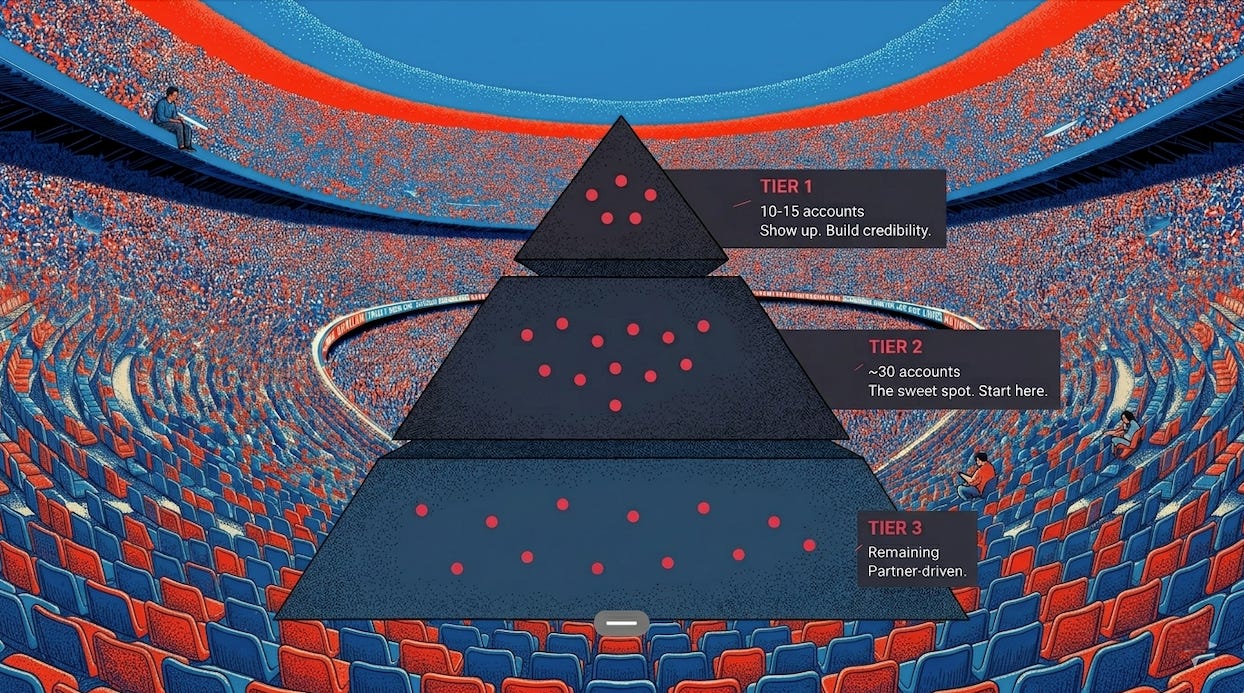
Tier one: your top 10 to 15 accounts. The largest exchanges with the biggest revenue potential and the longest sales cycles. All you are doing here early on is showing up. Executive dinners. Conference presence. Building credibility so that when the time comes, the door is already cracked open.
Tier two: your next 30 or so mid-size exchanges. This is the sweet spot. Large enough to generate meaningful revenue, nimble enough to move faster on new technology. Less red tape, shorter decisions. These are the accounts that carry startups through the early years, quarter after quarter.
Ideally, your whole GTM for tier two should be built around a zero-risk proposition. Pilot programs with clear timelines. Flexible terms. Maybe even performance-based pricing where you only get paid when they see results. Implementation in weeks, not quarters. No shelfware risk. When the ask is that clean, budget approval stops being a battle.
One caveat here: know your value. Making it easy to say yes does not mean underselling yourself. If you are getting into contracts where the cost of serving that customer is greater than the benefit, that is an early indicator of a sinking strategy. Tread carefully around those decisions.
Tier three: your remaining accounts. Lower priority, but valuable for market coverage and for rounding out your proof points across geographies. Oftentimes a partner or channel-driven strategy tends to be the most efficient way to attack this tier.
Here is the part most people get wrong. The sequence matters more than the tiers themselves. Win tier two first. Learn from them. Let your product mature with them. Build a wall of customer proof with them. Then go upstream to tier one with the operational maturity and the receipts to back it up.
Going after a top-tier logo before you are ready is one of the most expensive mistakes you can make in a finite market. If you land it and bomb it, that story will reach the rest of your TAM before your next board meeting.
3. Hire your buyer
One of the most underrated moves in finite-market marketing: hire someone who used to be your buyer.
In a market of 60, there are maybe a few hundred executives on earth who have ever made the kind of purchasing decision you are selling into. Hire one. Everything changes.
They know how decisions really get made inside those organizations, what keeps people up at night, and what actually moves a deal forward.
That hire brings maturity to the entire business. Go-to-market gets sharper. Product roadmap gets more focused. Customer success knows what to expect. And in a market where everybody knows everybody, they bring a network that no marketing budget can replicate.
4. Build an advisory board
Whether or not you can make the hire above, build a formal advisory board. Current customers willing to champion you, former executives from the world you are selling into, respected veterans who have been around long enough that people take their calls.
It gives you credibility with prospects who do not know you yet. It opens doors your sales team could spend months trying to open. And in a market of 60, the right introduction from the right person can move a deal forward faster than any campaign.
5. Build clusters and FOMO
In a finite market, competition is one of the most powerful forces you can use. The moment one exchange adopts something and starts seeing results, the others feel the pressure. Nobody wants to be the one falling behind in a market where everyone knows what everyone else is doing.

This is why you should think in clusters. Group your target accounts by whatever makes them likely to run into each other. Geographic proximity, similar size, same competitive set. Then focus your early wins inside those clusters. When three mid-size European exchanges are working with you and a fourth is not, that fourth exchange is hearing about it. At conferences, in working groups, in the hallway conversations that happen between sessions. The peer pressure does work that no outbound sequence ever could.
I have seen this play out in previous roles. At a previous company, we closed a major San Francisco tech company that everyone would recognize. It took nine months. We had to build roadmap items specifically for them. But once they were live and gave us a testimonial saying they ran a thorough evaluation and we turned out to be the most suitable partner, we put that everywhere. Every piece of material, every sales conversation, every conference slide.
The next three or four San Francisco tech companies closed in two to three months each. One of them told us directly: “If it’s good enough for those guys, it’s good enough for us.” Nine months became two. That is what clusters do to sales velocity.
Your content should support this. Create material that highlights the problem you are solving and what companies who are addressing it are gaining. You are not talking about your product here. You are talking about the gap between the companies that are moving on this and the ones that are not. Original research. Commissioned analyst reports. Data that your champion inside the account can take to their CFO to build the internal case for budget.
6. Customer proof is everything
In a market of 60, every single customer story is a signal to every other potential buyer. This is where you invest heavily.
Named case studies with real numbers. Video testimonials from customers willing to put their name on it. Joint presentations at industry conferences where you are on stage next to someone who chose you. Your prospects are not evaluating you against a blog post. They are asking each other. Make your customers look like geniuses for choosing you.
7. Offline beats digital
In a finite market, real business gets developed face to face. Offline is the primary channel. Digital plays a supporting role.
Map every relevant conference, summit, and association meeting for the year. Those are the moments when your potential customers are in the same building. Everything else you do between those events is air cover.

You do not need to sponsor from day one. Just attend. But do the work. Drive meetings ahead of each event through direct outreach by email, social, and if possible, phone. Then build “satellite events” around the main conference. A private dinner the night before for 12 to 15 executives. A smaller roundtable the morning after. These happen where your buyers are already gathering. The key is to make them worth attending for reasons that have nothing to do with your product. If you are selling to CROs, co-host with a VC firm. Those CROs will show up because they want to build relationships with investors, and you get the room. Pick a theme that matters to your audience, bring in a speaker or a perspective they cannot get elsewhere, and keep the sales pitch to a minimum. The conference badge gets you proximity. The “satellite events” get you relationships.
Where digital fits is in the supporting pieces. An ROI calculator on your website where prospects can plug in their own numbers. Analyst reports and original research, easy to find and share. Content designed to arm your champion with what they need to sell internally. These tools make the offline conversations more effective.
8. Reputation is the whole game
In a big market, you can afford to be messy. Burn a few leads, learn, iterate. A market of 60 does not give you that luxury. Every interaction either builds your reputation or damages it. There is no spray and pray. Just precise, thoughtful engagement with people who will remember exactly how you showed up. When you do it right, the market comes to you.
I used stock exchanges as the example, but the same logic applies if you are selling into any space where the total number of potential customers is limited and fairly small.
The playbook that dominates the internet was built for a different game. If you know every buyer by name, stop playing it.
✌️