

Right now, somewhere in your target market, a buyer just asked ChatGPT to recommend the best solution for a problem your product solves.
Three to five names came back. With reasoning attached.
That buyer built a shortlist without visiting a single website, reading a single blog post, or talking to a single rep. If your name was in that answer, you are in the conversation. If it was not, you will probably never hear about it.
This is already happening at scale. 71% of B2B software buyers now use AI chatbots to research vendors. More than half start their entire buying process with an AI query. And according to Bain, 95% of purchases go to a vendor that was already on the buyer’s initial shortlist.
The shortlist used to be built over weeks. Peer conversations, analyst reports, conference sightings, that piece of content they bookmarked six months ago. Now it gets built in seconds.
The invisible majority
A 2026 benchmark of B2B SaaS brands found that 96% have little to no visibility in AI-generated responses. In any given category, five brands capture 80% of the top answers. Everyone else is functionally invisible.
You could have a great product, a solid team, and years of customer proof, and still not exist in the place where your buyer starts their research.
Google gave you ten blue links on the first page. AI gives your buyer four to seven names. The bar got higher and the window got smaller.
Where AI gets its answers
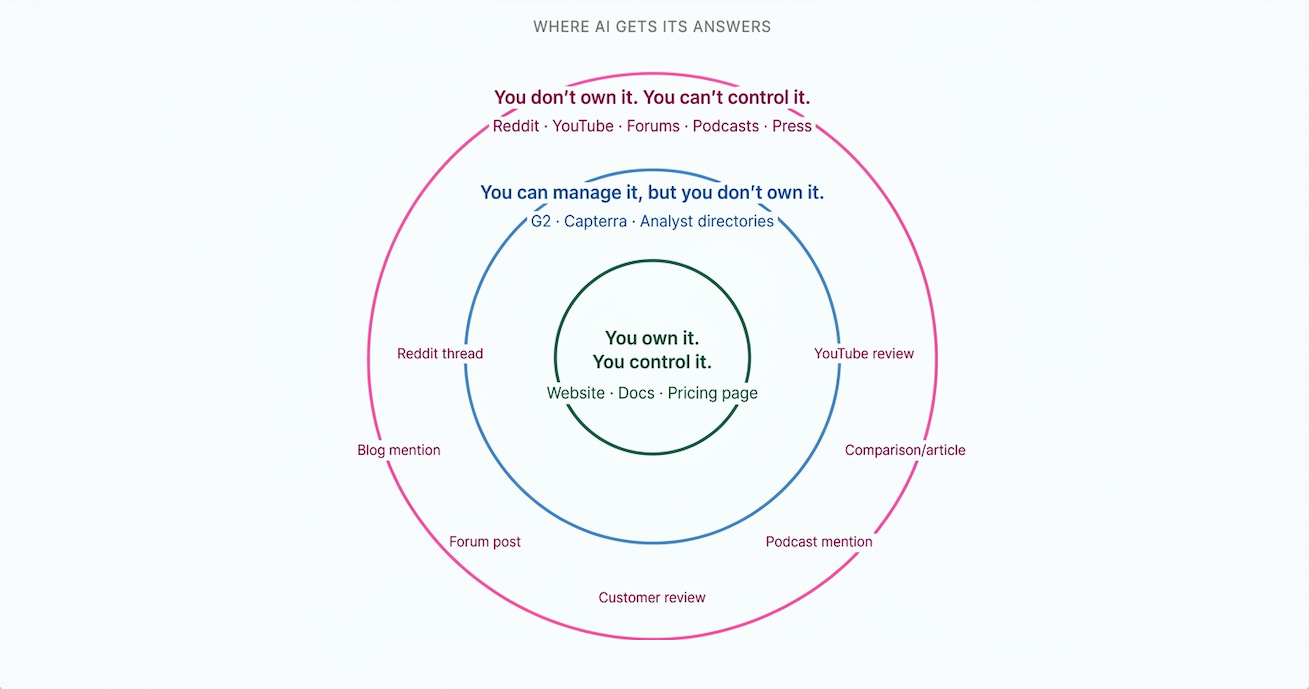
AI models pull from a wide mix of sources to build their responses. The tricky part is that you only control some of them.
The first layer is your own properties. Your website, your documentation, your pricing page. You change it, the information updates.
The second layer is domains you do not own but where you can manage your information. Think G2, Capterra, analyst directories. Your profile, your pricing, your positioning are all there. You can keep those current, but you have to do the work. Most companies set them up once and forget they exist.
The third layer is where it gets uncomfortable. These are sources you do not own and cannot control. YouTube videos where someone compared your product to three others. Reddit threads where a user described their experience with your platform. Wikipedia and Reddit alone account for over 25% of all ChatGPT citations. Community discussions, forum posts, podcast mentions. Content created by people who have no obligation to keep it accurate, no reason to check with you, and no incentive to be generous.
Maybe your pricing changed six months ago but five YouTube videos still show the old number. Maybe a frustrated customer posted something on Reddit that now shapes how the AI describes you to every buyer who asks. You can try reaching out, but you are at their mercy.
The end of narrative control
For years, the job was to control the story. Craft the positioning. Own the message. Make sure the market sees you the way you want to be seen.
AI search changes that. What it tells your buyer is the weighted average of everything being said about you across the internet. Your website is one input. Your customers, your users, your critics, community conversations, all of those are inputs too. And the AI does not rank them by which one you prefer.
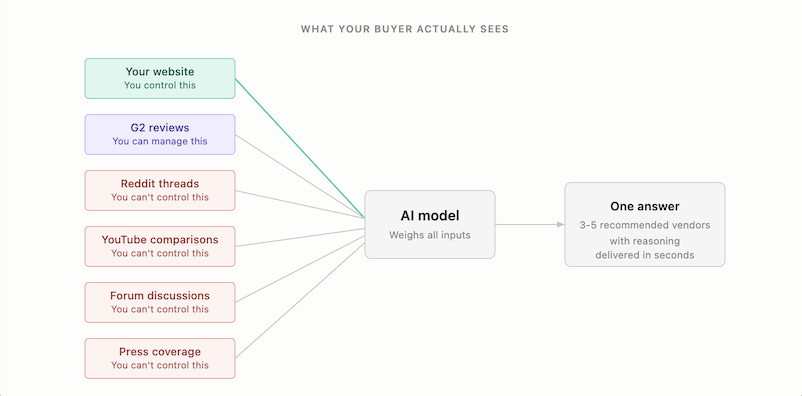
For marketers, that is a loss of control. For buyers, it is a better deal. They are getting something closer to the truth.
We have said for years that companies should be customer-centric. That what your buyers and users experience matters more than the messaging on your website. AI search forces that to actually be true. You cannot say you are the most reliable platform in the category and expect that to hold. If your users are saying something different, the AI will reflect that.
The companies where the external reputation matches the internal positioning are the ones that will show up well. The ones where there is a gap between the story and the reality… are going to feel it.
What this changes
This connects directly to what I wrote about RECALL. The 95% of buyers who are not in-market right now are still forming impressions. AI compressed how those impressions turn into decisions. When that buyer finally opens ChatGPT, what the AI surfaces reflects everything that has accumulated around your brand over time.
But the mix shifts. Content locked behind forms is invisible to AI. Corporate blog posts that only live on your domain carry less weight than a mention in a third-party publication. A case study on your website matters less than a customer talking about you on a forum, in a review, or in an industry podcast. The balance of effort has to tilt toward earned and borrowed visibility. Your name needs to show up in the places where AI goes looking: independent reviews, community threads, comparison articles, earned press, industry conversations.
The uncomfortable part is the timeline. You cannot fix this in a quarter. The research suggests six to eight months before you see measurable movement, with real compounding over 12 to 18 months. But if your product is delivering real value and your customers are genuinely happy, the AI will eventually reflect that. The signal is already out there in every review, every forum thread, every conversation where someone mentioned your name. It compounds whether you are paying attention to it or not.
The companies that should worry are the ones where the story on the website does not match the experience in the product. For everyone else, this is an advantage.
The truth is finally doing the marketing for you.
✌️