

The GitHub CTO post is titled “An update on GitHub availability.” The platform went down multiple times in April. Merge queues corrupted pull requests. Search collapsed. Uptime dropped below 85%.
But buried in that same post is a graph that tells one of the most interesting growth stories in tech right now. Pull requests, commits, and new repositories are all spiking to record highs. A sharp, vertical line starting around December 2025 and going straight up.
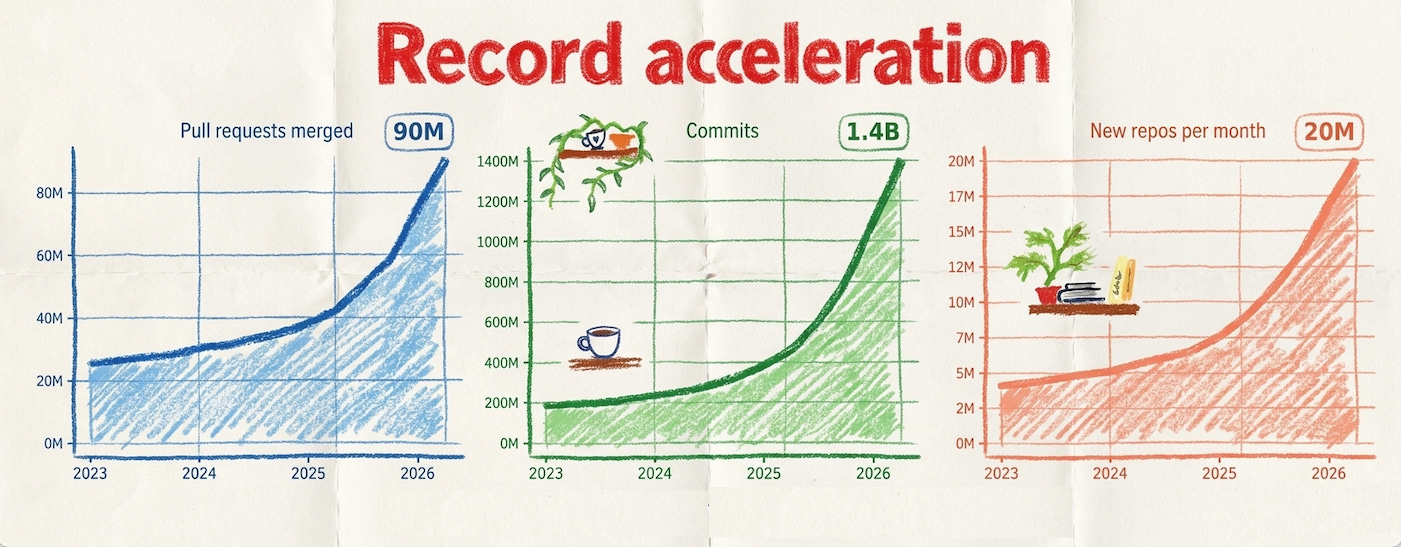
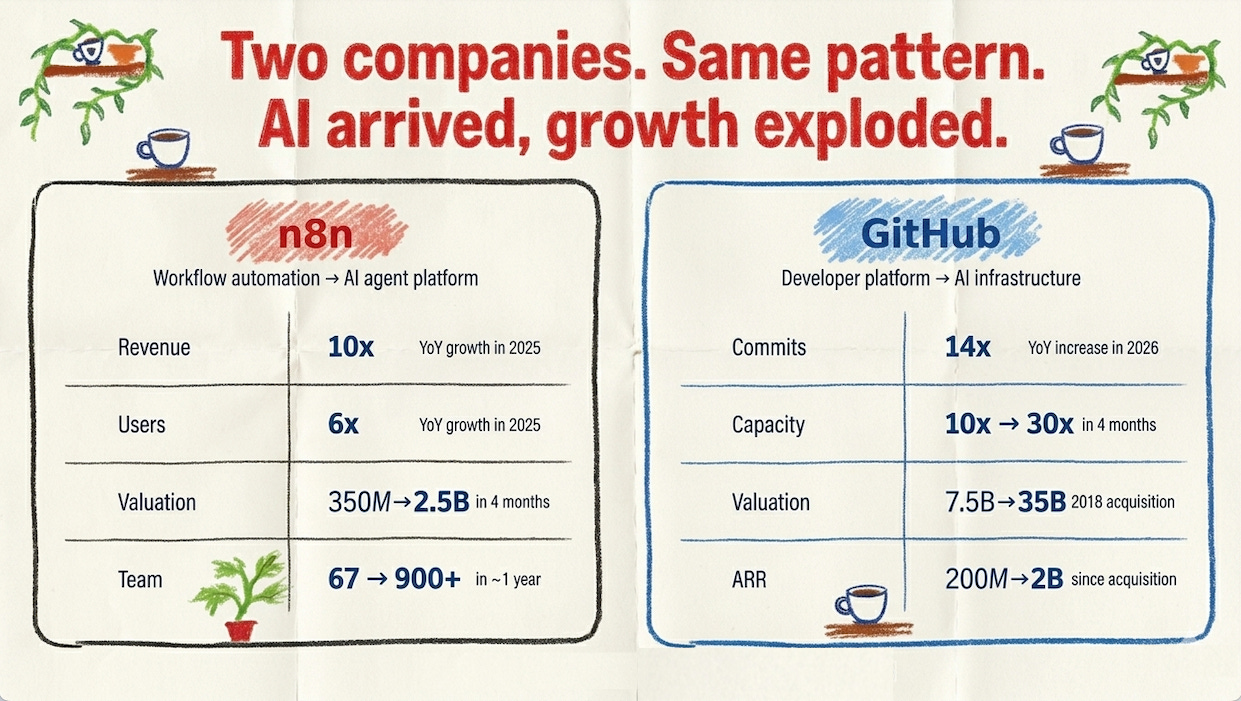
GitHub is now absorbing 275 million commits per week. On pace for 14 billion commits in 2026. That is a 14X increase over 2025. Fourteen times more.
The platform is breaking under the weight of growth so explosive that even one of the best-funded engineering teams in the world cannot scale infrastructure fast enough to keep up.
That is a very good problem to have.
When a decade of scaling needs to happen in months
In October 2025, GitHub started executing a plan to increase platform capacity by 10X. That is already an aggressive number. Most companies would call that a decade-long infrastructure project.
By February 2026, four months later, they realized 10X was not going to be enough. They needed 30X.
A company backed by Microsoft, with some of the best infrastructure engineers in the world, planned aggressively for a growth wave and still underestimated it by three times in four months.
What happened?
AI tools like Claude Code, Copilot agents, and Cursor went from interesting experiments to daily workflows.
Now anyone can describe what they want in plain English, and the AI writes the code, commits it to GitHub, and opens a pull request. Marketers, product managers, founders, analysts who had never opened a terminal started showing up on the platform. Some are vibe coding entire applications. Others are using GitHub as a central brain for their teams, building knowledge systems in Markdown files. All version-controlled, all reviewable.
GitHub accidentally became the platform for everyone who works with AI. The outages are just a side effect.
What all of this means for GitHub as a business
Microsoft bought GitHub in 2018 for $7.5 billion. A lot of people thought they overpaid. GitHub was generating somewhere between $200 and $300 million in revenue at the time.
Today, GitHub’s annual revenue run rate is $2 billion. The estimated valuation sits around $35 billion. Nearly five times what Microsoft paid. Over 40% of that revenue growth comes from Copilot, their AI coding assistant. 4.7 million paid subscribers. 140,000 organizations. Enterprise subscribers nearly tripled year over year.
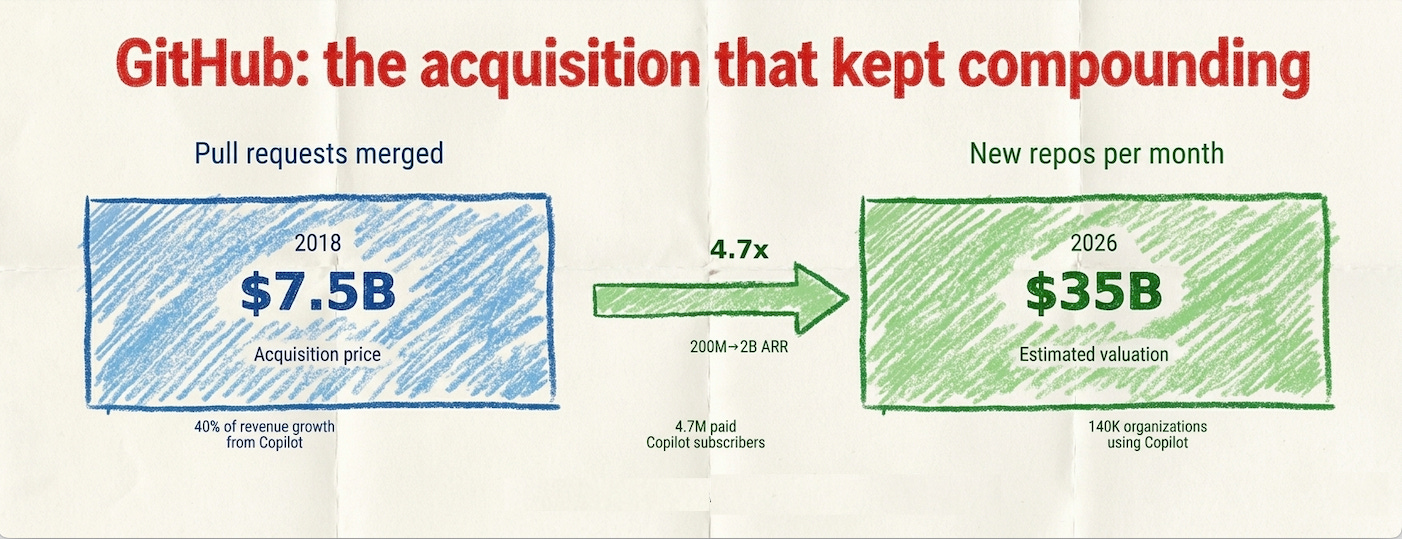
None of this was in the original thesis. When Microsoft wrote that check, Copilot did not exist. AI agents flooding the platform with 275 million commits a week was not in anyone’s model. They bought the platform, kept investing in it, kept it open. And then the world shifted in a direction nobody predicted, and that shift landed directly on top of what they had already built.
GitHub is not the only one
n8n has a similar story. They launched in 2019 as a workflow automation tool. Solid product, steady inbound growth, fair-code model. A good business doing fine.
Then AI agents needed a way to chain tasks together. And n8n was already built for exactly that. When the opportunity showed up, they went all in. In 2025, their revenue grew 10X. Users grew 6X. 80% of workflows on the platform now involve AI agents. Their valuation jumped from $350 million to $2.5 billion in four months. They scaled from around 67 employees to over 900 in about a year to meet the demand.
You cannot predict this kind of thing. You cannot put “global AI wave redirects all workflow traffic to our platform” in a board deck and expect anyone to take you seriously. These are moments that happen to you.
But the wave arriving is only half the story. What happens next is where the real work starts. Scaling infrastructure, making the right calls under pressure, hiring fast enough, keeping the product stable while everything around it is accelerating. GitHub is doing that in public right now, writing apology blog posts while simultaneously redesigning for 30X capacity. n8n scaled their entire team by 12X in a year. None of that happens without strong leadership and sharp execution. The timing was lucky. Everything after that was earned.
Why this matters if you are in marketing
My LinkedIn feed is full of conversations about GitHub and Claude right now. Marketers are building internal tools, writing automation scripts, shipping projects that used to require an engineering ticket. A year ago, none of that was happening.
The business lesson is what sticks with me. GitHub never ran a growth campaign targeting non-developers. n8n saw the AI wave early and leaned into it hard. Both had spent years building something solid, and when the world shifted, that shift found their platforms.
Every company builds for the market it can see. Sometimes the biggest growth comes from a market you did not know existed, showing up because something shifted underneath everyone’s feet. The “breaking” is just what that kind of growth looks like before the infrastructure catches up.
✌️
PS: If you are interested in learning how to build an AI-native marketing team using GitHub and Claude, I wrote a three-part series on how we are doing exactly that at Rocket.Chat.


